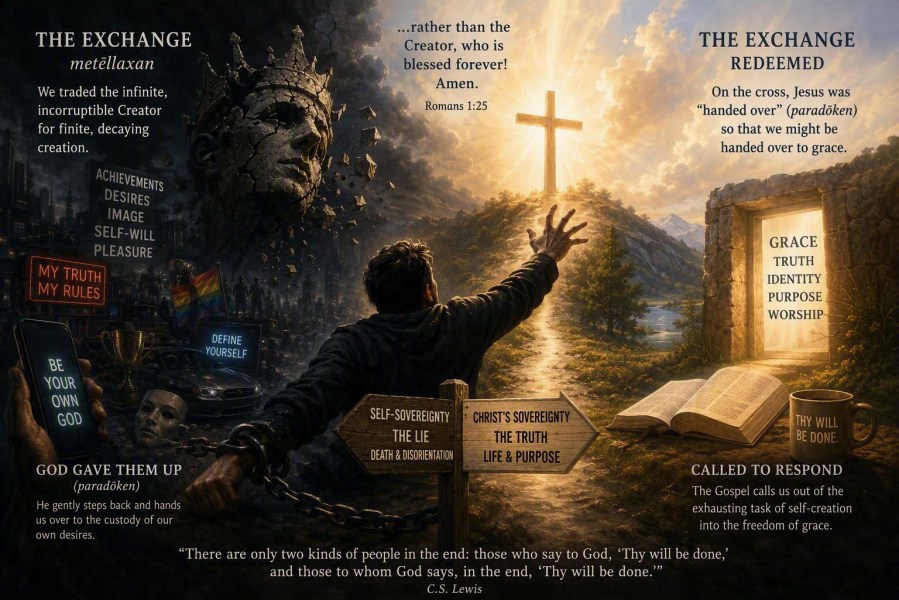
Romans 1:21–25 (ESV) For although they knew God, they did not honor him as God or give thanks to him, but they became futile in their thinking, and their foolish hearts were darkened. 22 Claiming to be wise, they became fools, 23 and exchanged the glory of the immortal God for images resembling mortal man and birds and animals and creeping things. 24 Therefore God gave them up in the lusts of their hearts to impurity, to the dishonoring of their bodies among themselves, 25 because they exchanged the truth about God for a lie and worshiped and served the creature rather than the Creator, who is blessed forever! Amen.
At the heart of human history lies a silent, catastrophic transaction. In Romans 1:21–25, Paul uncovers the tragic psychology of our spiritual downfall. The collapse of a human heart. This condition never begins with outward moral decay; it begins in the quiet sanctuary of the soul with two subtle postures: a refusal to honor God as God and a refusal to give Him thanks.
When we enjoy God’s gifts, our breath, intellect, relationships, and natural order, without acknowledging the Giver, we cut ourselves off from the Source of reality. Detached from truth, human reasoning becomes futile, our hearts are darkened, and in our self-proclaimed wisdom, we become fools.
Paul defines this collapse using a word rich with tragedy: “Exchanged” (metēllaxan) – to exchange, to substitute
We traded the infinite, incorruptible Creator for finite, decaying creation, and we swapped the truth, that God is supreme and worthy of ultimate allegiance, for “the lie” (tō pseudei), the ancient Edenic delusion that we can be our own gods, defining our own reality, morality, and identity.
We never stop worshiping. When we dethrone God, we simply crown something within the created order in His place: our achievements, our desires, our image, or our self-will.
How does God respond to humanity’s deliberate exchange? Three times in Romans 1, Paul repeats a haunting phrase: “God gave them up” (paradōken).
We often picture divine wrath as lightning from heaven or sudden, catastrophic destruction. But Paul reveals a far more sobering reality: God’s judgment is often judicial abandonment. Paradōken is a legal term meaning “to surrender a prisoner to custody.” When humanity demands freedom from God’s rule, God does not force His presence upon us. In His passive, judicial wrath, He gently steps back, lifts His restraining grace, and hands us over to the custody of our own desires.
C.S. Lewis wrote this about this condition: “There are only two kinds of people in the end: those who say to God, ‘Thy will be done,’ and those to whom God says, in the end, ‘Thy will be done.'”
Under Paul’s framework, sin becomes its own immediate punishment. The misery, relational breakdown, and loss of grounding we experience in a world detached from God are not arbitrary penalties; they are the natural, bitter fruit of getting exactly what we asked for: life without God.
In Romans 1:26–27, Paul demonstrates that our vertical rebellion against the Creator inevitably mirrors itself horizontally in our physical and relational lives. Using the exact same word, Paul writes that because humanity exchanged (metēllaxan) the truth of God for a lie vertically, we began to exchange natural design for what is contrary to design horizontally. When a society cuts the anchor of God’s sovereignty, the human body and identity are no longer seen as purposeful gifts to be honored according to the Creator’s wisdom. Instead, they become raw material to be redefined by human preference.
When we see cultural confusion, fractured identities, and the elevation of self-expression as the ultimate good, we are not looking at isolated political debates; we are looking at a world living in the shadow of paradōken. It is the poignant story of humanity insisting on self-sovereignty, only to discover the deep disorientation that follows when we try to manufacture our own purpose apart from the One who made us.
Yet, right in the middle of this sober diagnosis, Paul pauses in verse 25 to declare a spontaneous outburst of praise: “…rather than the Creator, who is blessed forever! Amen.”
Even when human culture actively rejects Him, God’s majesty remains unsullied and supreme. He is still the blessed Creator, full of grace and truth.
This doxology reminds us where our hope lies. The answer to a culture caught in “the exchange” is not hostility, moral outrage, or self-righteous pride. Left to ourselves, every single one of us has traded God’s glory for lesser things.
The Gospel calls us out of the exhausting task of self-creation and self-justification. On the cross, Jesus Christ was “handed over” (paradōken) to the full penalty of our rebellion so that we might be handed over to grace.
Refrences:
BDAG (Bauer, Danker, Arndt, and Gingrich): Bauer, Walter, Frederick W. Danker, William F. Arndt, and F. Wilbur Gingrich. A Greek-English Lexicon of the New Testament and Other Early Christian Literature. 3rd ed. Chicago: University of Chicago Press, 2000.
Thayer’s Greek-English Lexicon of the New Testament: Thayer, Joseph Henry. A Greek-English Lexicon of the New Testament. New York: American Book Company, 1889
TDNT (Theological Dictionary of the New Testament): Kittel, Gerhard, and Gerhard Friedrich, eds. Theological Dictionary of the New Testament. Translated by Geoffrey W. Bromiley. 10 vols. Grand Rapids, MI: Eerdmans, 1964–1976.
NIDNTTE (New International Dictionary of New Testament Theology and Exegesis): Silva, Moisés, ed. New International Dictionary of New Testament Theology and Exegesis. 2nd ed. 5 vols. Grand Rapids, MI: Zondervan, 2014.
C. S. Lewis, The Great Divorce (New York: Macmillan, 1946), chap. 9.
Image Created by Copilot AI based on text of post.


No argument here. If you go back to the reason God through Moses asked Pharaoh to release God’s people (slavery to freedom, i.e. salvation), it was so that they would “worship and serve” Him in the desert…The true goal of the Gospel. An eternal gospel which proclaims: “Fear God and give Him glory…[w]orship Him who made the heavens, the earth, the sea and the springs of water.” (Revelation 14:6-7). When Jesus is tempted by Satan and the ultimate temptation is given to do an “exchange” with Satan (the lie or “to pseudei”), i.e. for Jesus to accept from a creature – Satan – what only the Creator could ultimately provide and if ONLY Jesus would “bow and worship” the creature – Self first but ultimately, Satan…Jesus replies with ultimate TRUTH to the ultimate LIE. Matthew 4:10, “Away from me, Satan! For it is written: ‘Worship the Lord your God, and serve Him only.” (See also Deut 6:13)
This is a big deal. Idols and idolatry. God certainly thinks it’s the biggest deal when he says: “I am the LORD; that is My Name! I will not yield my glory to another or my praise to idols.” (Isaiah 42:8) Even “good” things that are beautiful or noble can become idols. The litmus test in Romans 1:25 and repeated over and over in all of Scriptures has been enormously helpful to me, not in discerning between what is pagan and “Christian” but rather between what is and has become acceptable but is idolatrous within “Christianity”: The difference between “Who” we “worship and serve” (Creator) versus “what” (created things) we “worship and serve” and as a result, end up “worshipping and serving” our-SELVES. It is subtle like a snake (Genesis 3). It is deceptive because I am inclined to believe it as true (Jeremiah 17:9). It is harmful and self-destructive to one’s own “wholeness”. It is an end unto itself – a “dead” end even while seeming to be “right” (see Proverbs 16:25).
I am reminded that our “Orthopraxy” must match our “Orthodoxy” (and often does, for good or bad). But orthodoxy technically isn’t merely “good doctrine” or “good teaching” or “good beliefs” unless it is able to first say fundamentally that it is “right practice” (Orthopraxy – How we Serve) because of “right praise” (Orthodoxy – Who we Worship). It is all about whether our practice or our teachings “worship and serve” the One True Creator God or whether they are just useful to assist us in the “worship and service” ultimately of ourselves. Doesn’t sound practical? Apply that litmus test to “Ted talk” style sermons, evangelistic outreach that is more concerned with church marketing to a consumer society than it is to being faithful witnesses of God’s truth and grace or without even getting much farther than the nomenclature itself, “Christian nationalism.” Sounds like “Jesus and (fill in the blank)” to me which sounds a lot like an “idol”, don’t you think? (Asking for a friend: Does God share His glory with America somehow?) Does the litmus test work? Is it possible God could just as well give us over to our own devices in creating a “Christianity” that is useful for/to us without ever having to bow to Him or asking Him what He truly wants of us. Sadly, I think so. It’s an exchange. As the great Sponge Bob would say followed by his relentless giggle: “Good luck with that!”