Climatic Indictment

Romans 1:32 (ESV) Though they know God’s righteous decree that those who practice such things deserve to die, they not only do them but give approval to those who practice them.

Romans 1 forms a haunting chiastic spiral—a literary mirror where the end of Paul’s indictment directly reflects its beginning, exposing the full depth of human decline:

  • Knowledge of God’s Truth (vv. 19–21) -> Suppressed for Autonomy (v. 18)
    • B. Threefold “Handing Over” (Paradōken) to standardless living (vv. 24, 26, 28)
  • Knowledge of God’s Decree (v. 32) -> Fully Inverted into Systemic Approval

Verse 32 serves as the capstone of this spiral. Paul reveals that humanity acts with full epignontes, an undeniable, experiential knowledge of God’s righteous standard (dikaiōma). Deep down, we know that cosmic treason against the Giver of life carries a death sentence (axioi thanatou). We are without excuse.

Yet the final, lowest turn of this spiral is not mere personal failure; it is systemic endorsement. Paul exposes this through a chilling pivot: “not only… but also.”

It is one thing to stumble into sin through weak, fleeting impulse (poiousin). It is another to applaud it (syneudokousin). To approve, celebrate, and institutionalize rebellion requires a cold, intellectual alignment with evil. It completes the inversion: what began as suppressing the truth ends as building a culture that calls evil good and good evil.

Tragically, this spiral does not stop at the church doors.

When we rewrite Scripture to match culture, scrub the reality of sin to keep messages market-friendly, or turn worship into a consumer-driven show, we repeat the exact trajectory of Romans 1. We exchange internal awe (esebasthēsan) for performative entertainment, subtly shifting the message from “Surrender to King Jesus” to “Let God enhance your self-sovereignty.” In doing so, we give tacit approval to the very rebellion Christ came to forgive.

God’s grace does not call us to bless the world’s rebellion or mirror its spiral. It summons us into “the obedience of faith” (Rom. 1:5). His grace doesn’t just ask us to stop doing what grieves Him; it transforms our hearts so we stop loving and applauding it.

Search your heart today. Where have you moved from battling weakness to applauding compromise in your media, your culture, or your church? Turn back to the uncompromised Gospel (Rom. 1:16–17). It alone breaks the spiral, exposes our rebellion, and offers a life anchored in true, unshakeable joy.

Prayer: Lord, forgive us for celebrating or accommodating things that grieve Your Spirit. Open our eyes to the subtle spirals of compromise in our own hearts and churches. Strip away our desire to validate rebellion, and give us the courage to delight only in Your holy truth. Amen.

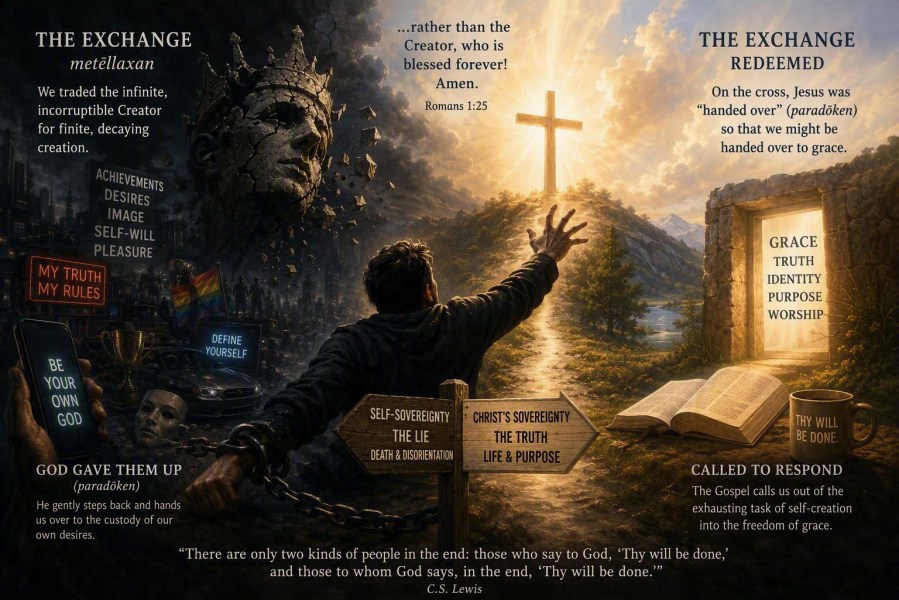
The Great Exchange

Romans 1:21–25 (ESV) For although they knew God, they did not honor him as God or give thanks to him, but they became futile in their thinking, and their foolish hearts were darkened. 22 Claiming to be wise, they became fools, 23 and exchanged the glory of the immortal God for images resembling mortal man and birds and animals and creeping things. 24 Therefore God gave them up in the lusts of their hearts to impurity, to the dishonoring of their bodies among themselves, 25 because they exchanged the truth about God for a lie and worshiped and served the creature rather than the Creator, who is blessed forever! Amen.

At the heart of human history lies a silent, catastrophic transaction. In Romans 1:21–25, Paul uncovers the tragic psychology of our spiritual downfall. The collapse of a human heart. This condition never begins with outward moral decay; it begins in the quiet sanctuary of the soul with two subtle postures: a refusal to honor God as God and a refusal to give Him thanks.

When we enjoy God’s gifts, our breath, intellect, relationships, and natural order, without acknowledging the Giver, we cut ourselves off from the Source of reality. Detached from truth, human reasoning becomes futile, our hearts are darkened, and in our self-proclaimed wisdom, we become fools.

Paul defines this collapse using a word rich with tragedy: “Exchanged” (metēllaxan) – to exchange, to substitute

We traded the infinite, incorruptible Creator for finite, decaying creation, and we swapped the truth, that God is supreme and worthy of ultimate allegiance, for “the lie” (tō pseudei), the ancient Edenic delusion that we can be our own gods, defining our own reality, morality, and identity.

We never stop worshiping. When we dethrone God, we simply crown something within the created order in His place: our achievements, our desires, our image, or our self-will.

How does God respond to humanity’s deliberate exchange? Three times in Romans 1, Paul repeats a haunting phrase: “God gave them up” (paradōken).

We often picture divine wrath as lightning from heaven or sudden, catastrophic destruction. But Paul reveals a far more sobering reality: God’s judgment is often judicial abandonment. Paradōken is a legal term meaning “to surrender a prisoner to custody.” When humanity demands freedom from God’s rule, God does not force His presence upon us. In His passive, judicial wrath, He gently steps back, lifts His restraining grace, and hands us over to the custody of our own desires.

C.S. Lewis wrote this about this condition: “There are only two kinds of people in the end: those who say to God, ‘Thy will be done,’ and those to whom God says, in the end, ‘Thy will be done.'”

Under Paul’s framework, sin becomes its own immediate punishment. The misery, relational breakdown, and loss of grounding we experience in a world detached from God are not arbitrary penalties; they are the natural, bitter fruit of getting exactly what we asked for: life without God.

In Romans 1:26–27, Paul demonstrates that our vertical rebellion against the Creator inevitably mirrors itself horizontally in our physical and relational lives. Using the exact same word, Paul writes that because humanity exchanged (metēllaxan) the truth of God for a lie vertically, we began to exchange natural design for what is contrary to design horizontally. When a society cuts the anchor of God’s sovereignty, the human body and identity are no longer seen as purposeful gifts to be honored according to the Creator’s wisdom. Instead, they become raw material to be redefined by human preference.

When we see cultural confusion, fractured identities, and the elevation of self-expression as the ultimate good, we are not looking at isolated political debates; we are looking at a world living in the shadow of paradōken. It is the poignant story of humanity insisting on self-sovereignty, only to discover the deep disorientation that follows when we try to manufacture our own purpose apart from the One who made us.

Yet, right in the middle of this sober diagnosis, Paul pauses in verse 25 to declare a spontaneous outburst of praise: “…rather than the Creator, who is blessed forever! Amen.”

Even when human culture actively rejects Him, God’s majesty remains unsullied and supreme. He is still the blessed Creator, full of grace and truth.

This doxology reminds us where our hope lies. The answer to a culture caught in “the exchange” is not hostility, moral outrage, or self-righteous pride. Left to ourselves, every single one of us has traded God’s glory for lesser things.

The Gospel calls us out of the exhausting task of self-creation and self-justification. On the cross, Jesus Christ was “handed over” (paradōken) to the full penalty of our rebellion so that we might be handed over to grace.

Refrences:

BDAG (Bauer, Danker, Arndt, and Gingrich): Bauer, Walter, Frederick W. Danker, William F. Arndt, and F. Wilbur Gingrich. A Greek-English Lexicon of the New Testament and Other Early Christian Literature. 3rd ed. Chicago: University of Chicago Press, 2000.

Thayer’s Greek-English Lexicon of the New Testament: Thayer, Joseph Henry. A Greek-English Lexicon of the New Testament. New York: American Book Company, 1889

TDNT (Theological Dictionary of the New Testament): Kittel, Gerhard, and Gerhard Friedrich, eds. Theological Dictionary of the New Testament. Translated by Geoffrey W. Bromiley. 10 vols. Grand Rapids, MI: Eerdmans, 1964–1976.

NIDNTTE (New International Dictionary of New Testament Theology and Exegesis): Silva, Moisés, ed. New International Dictionary of New Testament Theology and Exegesis. 2nd ed. 5 vols. Grand Rapids, MI: Zondervan, 2014.

C. S. Lewis, The Great Divorce (New York: Macmillan, 1946), chap. 9.

Image Created by Copilot AI based on text of post.

The Torah of Yahweh (Part 1)

Blessed is the man who does not walk in the advice of the wicked; nor does he stand in the way of sinners; nor does he sit in the assembly of mockers. Instead, in the law of Yahweh is his delight, and on his law he meditates day and night.” (Psalm 1:1–2, LEB)

When you move through the Psalms you can’t help but experience the deep love the writers had for God’s word. I don’t think it is an accident that the book of Psalms starts its first stanza with words like delight and meditate. In Psalm 19, the writer looks at the revelation of God in the universe, and pairs it with the beauty of the word of God. One commentator put it this way…

The very sound of the two movements of the psalm tells something of their two concerns: the broad sweep of God’s wordless revelation in the universe, expressed in the exuberant lines of verses 1–6, and the clarity of his written word, reflected in the quiet conciseness of verses 7–10, to which the heart-searching of 11–14 is the worshipper’s response.[2]

Today, there seems to be a fierce attack on the Word of God. The methods of this attack may change but the underlying message is still the same – did God really say?

The word used in our english for Torah is law. This is also a huge problem since “law” brings many pre-concieved ideas from our culture that just are not true of the Bible.

The basic idea behing the word Torah is to throw, cast, or to shoot an arrow at the mark. The Theological Dictionary of the Old Testament defines the scope of this word very nicly…

The word tôrâ means basically “teaching” whether it is the wise man instructing his son or God instructing Israel. The wise give insight into all aspects of life so that the young may know how to conduct themselves and to live a long blessed life (Prov 3:1f.). So too God, motivated by love, reveals to man basic insight into how to live with each other and how to approach God. Through the law God shows his interest in all aspects of man’s life which is to be lived under his direction and care. Law of God stands parallel to word of the Lord to signify that law is the revelation of God’s will[1]

What an amazing thought that God’s compassion and love are poured out through his instruction to allow us to live with each other and be able to approach God. Paul a man who lived by that instruction did not look at that instruction as a burden, but as a gift that reveals his standing before God…

Yet if it had not been for the law, I would not have known sin. For I would not have known what it is to covet if the law had not said, “You shall not covet.”” (Romans 7:7, ESV)

This verse from chapter 7 of Romans continues a theme Paul starts back in Romans chapter 5, then he drives it all home in Romans 7:25…

Thanks be to God through Jesus Christ our Lord! So then, I myself serve the law of God with my mind, but with my flesh I serve the law of sin.” (Romans 7:25, ESV)

The word “Serve” that Paul uses means to be a slave to, controlled by, or to serve. So even though Paul struggled in the flesh with sin, his mind was controlled by the Lord. We see this re-emphasized in Romans 8:5…

For those who live according to the flesh set their minds on the things of the flesh, but those who live according to the Spirit set their minds on the things of the Spirit.” (Romans 8:5, ESV)

How is this done, how do we set our minds on things of the spirit? It is in the same book a few chapters later that Paul tells us to not be conformed to this age, literally to not be in union with the patterns and fashion of the existing culture. “But to be transformed by the renewal of your mind, so that you may approve what is the good and well-pleasing and perfect will of God”. How can we know what is the good and well-pleasing and perfect will of God? The Psalmist knew…read and meditate on Psalm 119 and you can see just how much the word of God can do in the life of a believer.


[1] Hartley, J. E. (1999). 910 יָרָה. R. L. Harris, G. L. Archer Jr., & B. K. Waltke (Eds.), Theological Wordbook of the Old Testament (electronic ed., p. 404). Chicago: Moody Press.

[2]Kidner, D. (1973). Psalms 1–72: an introduction and commentary (Vol. 15, p. 114). Downers Grove, IL: InterVarsity Press.