Romans 5:12–15 (ESV) Therefore, just as sin came into the world through one man, and death through sin, and so death spread to all men because all sinned— 13 for sin indeed was in the world before the law was given, but sin is not counted where there is no law. 14 Yet death reigned from Adam to Moses, even over those whose sinning was not like the transgression of Adam, who was a type of the one who was to come. 15 But the free gift is not like the trespass. For if many died through one man’s trespass, much more have the grace of God and the free gift by the grace of that one man Jesus Christ abounded for many.
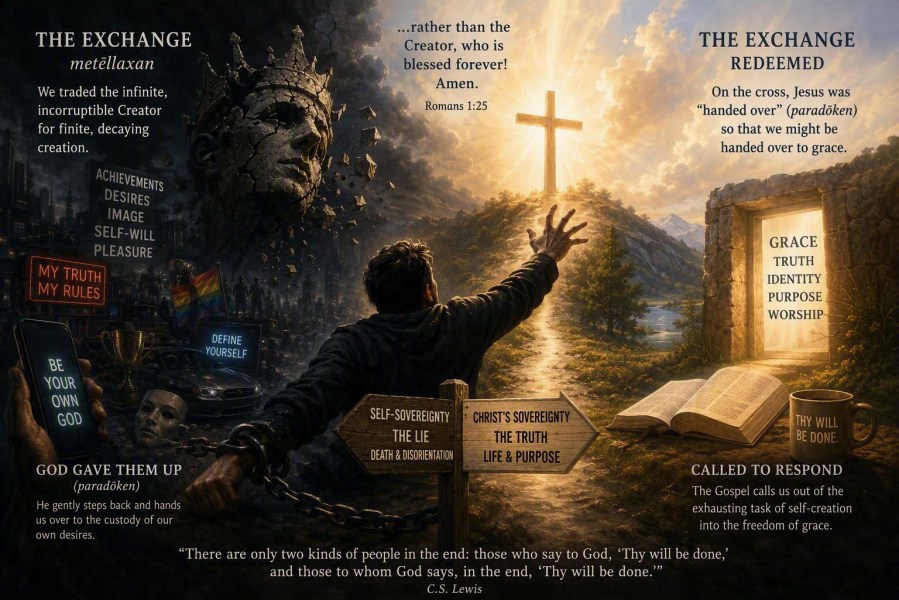
We tend to view our lives as a series of isolated, individual choices. We like to believe that our story is entirely our own to write—that we are the sole authors, judges, and rulers of our own reality.
Yet in Romans 5, Paul pulls back the curtain on a massive, hidden infrastructure. From God’s perspective, you are never an isolated individual in a spiritual vacuum. All of humanity operates within one of two spiritual realms, governed by one of two covenant heads: Adam or Jesus Christ.
In Adam, a single trespass opened the floodgates to a hostile tyrant: Sin.
Sin was never just an occasional mistake or a minor moral flaw. In Paul’s theology, Sin acts as a reigning, personified power (hypo hamartian) that brought physical, spiritual, and relational death into creation. Through Adam’s original disobedience, every one of his natural descendants was constituted under a heavy legacy of guilt, moral inability, and condemnation (katakrima).
Under this reign, death ruled as an undisputed king over a captive world.
Even when God introduced the Mosaic Law later in history, it could not rescue us from Adam’s realm. The Law entered alongside human history not to fix our hearts, but to expose the hidden disease of sin—turning our quiet self-autonomy into explicit rebellion. It acted as a mirror, stopping every mouth and proving that no amount of personal law-keeping, moral striving, or self-improvement could bridge the chasm. Left in Adam, we were trapped in absolute spiritual bankruptcy.
Into this broken heritage breaks the Second Adam—Jesus Christ.
Where Adam’s single failure brought condemnation to many, Christ’s single, perfect act of obedience on the cross answers a mountain of trespasses with justification (dikaiōsis). The Gospel reveals an astonishing asymmetry: Christ’s redemptive power does not merely balance the scales against Adam’s ruin—it far surpasses it!
On the cross, the ultimate legal exchange took place:
- Our guilt and sin were imputed (reckoned) directly to Christ.
- His perfect righteousness is credited to our spiritual account by faith alone, entirely apart from our merit or performance.
Through this great work, the tyrannical hold of death is broken. Those who receive the abundance of grace and the free gift of righteousness do not merely escape judgment—they are invited to reign in life through Jesus Christ.
In the world of theology, this dynamic is known as federal headship (or covenantal representation). It is the biblical framework establishing that every person is represented before God’s legal courtroom by one of two representatives: Adam or Christ.
- In Adam: Adam acted as our legal representative in the Garden. When he rebelled, his guilt and the resulting penalty of spiritual and physical death were judicially credited to all his descendants, constituting humanity as “under sin”.
- In Christ: Jesus serves as the “Last Adam” and federal head for all who believe. His single act of perfect obedience results in His righteousness being credited directly to our account, securing justification and eternal life apart from human merit.
You cannot stand in both realms at once. The Christian life is not about trying to reform your old standing in Adam through religious effort. It is about stepping down off the fragile throne of self-rule and resting completely in the finished work of King Jesus.
Where sin abounded under the first head, the grace of God has superabounded all the more under the Second.
Which head represents you today—the self-autonomy that leads to death, or the Savior who reigns in life?
Heavenly Father,
Thank You for sending Jesus Christ, the Last Adam, to accomplish what I could never achieve. Thank You that His single act of obedience on the cross satisfied Your divine justice, silenced my condemnation, and credited His very righteousness to my account. Where my sin abounded, Your grace has superabounded all the more.
Help me walk today not in the weary legalism of self-reliance, but in the freedom, life, and joy of union with Christ. Let Your grace reign in my heart, transforming my mind and empowering my steps for Your glory.