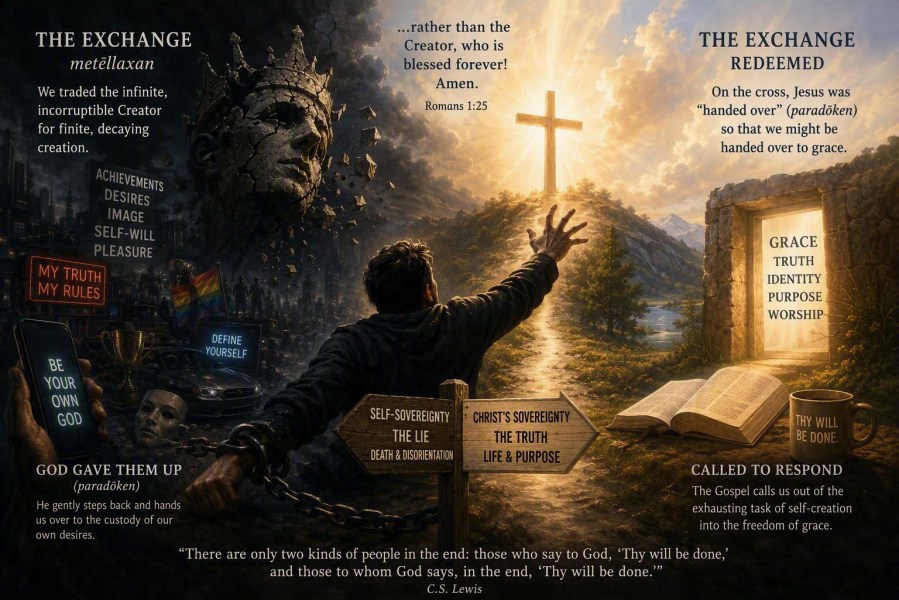
The Great Exchange

Romans 1:21–25 (ESV) For although they knew God, they did not honor him as God or give thanks to him, but they became futile in their thinking, and their foolish hearts were darkened. 22 Claiming to be wise, they became fools, 23 and exchanged the glory of the immortal God for images resembling mortal man and birds and animals and creeping things. 24 Therefore God gave them up in the lusts of their hearts to impurity, to the dishonoring of their bodies among themselves, 25 because they exchanged the truth about God for a lie and worshiped and served the creature rather than the Creator, who is blessed forever! Amen.

At the heart of human history lies a silent, catastrophic transaction. In Romans 1:21–25, Paul uncovers the tragic psychology of our spiritual downfall. The collapse of a human heart. This condition never begins with outward moral decay; it begins in the quiet sanctuary of the soul with two subtle postures: a refusal to honor God as God and a refusal to give Him thanks.

When we enjoy God’s gifts, our breath, intellect, relationships, and natural order, without acknowledging the Giver, we cut ourselves off from the Source of reality. Detached from truth, human reasoning becomes futile, our hearts are darkened, and in our self-proclaimed wisdom, we become fools.

Paul defines this collapse using a word rich with tragedy: “Exchanged” (metēllaxan) – to exchange, to substitute

We traded the infinite, incorruptible Creator for finite, decaying creation, and we swapped the truth, that God is supreme and worthy of ultimate allegiance, for “the lie” (tō pseudei), the ancient Edenic delusion that we can be our own gods, defining our own reality, morality, and identity.

We never stop worshiping. When we dethrone God, we simply crown something within the created order in His place: our achievements, our desires, our image, or our self-will.

How does God respond to humanity’s deliberate exchange? Three times in Romans 1, Paul repeats a haunting phrase: “God gave them up” (paradōken).

We often picture divine wrath as lightning from heaven or sudden, catastrophic destruction. But Paul reveals a far more sobering reality: God’s judgment is often judicial abandonment. Paradōken is a legal term meaning “to surrender a prisoner to custody.” When humanity demands freedom from God’s rule, God does not force His presence upon us. In His passive, judicial wrath, He gently steps back, lifts His restraining grace, and hands us over to the custody of our own desires.

C.S. Lewis wrote this about this condition: “There are only two kinds of people in the end: those who say to God, ‘Thy will be done,’ and those to whom God says, in the end, ‘Thy will be done.'”

Under Paul’s framework, sin becomes its own immediate punishment. The misery, relational breakdown, and loss of grounding we experience in a world detached from God are not arbitrary penalties; they are the natural, bitter fruit of getting exactly what we asked for: life without God.

In Romans 1:26–27, Paul demonstrates that our vertical rebellion against the Creator inevitably mirrors itself horizontally in our physical and relational lives. Using the exact same word, Paul writes that because humanity exchanged (metēllaxan) the truth of God for a lie vertically, we began to exchange natural design for what is contrary to design horizontally. When a society cuts the anchor of God’s sovereignty, the human body and identity are no longer seen as purposeful gifts to be honored according to the Creator’s wisdom. Instead, they become raw material to be redefined by human preference.

When we see cultural confusion, fractured identities, and the elevation of self-expression as the ultimate good, we are not looking at isolated political debates; we are looking at a world living in the shadow of paradōken. It is the poignant story of humanity insisting on self-sovereignty, only to discover the deep disorientation that follows when we try to manufacture our own purpose apart from the One who made us.

Yet, right in the middle of this sober diagnosis, Paul pauses in verse 25 to declare a spontaneous outburst of praise: “…rather than the Creator, who is blessed forever! Amen.”

Even when human culture actively rejects Him, God’s majesty remains unsullied and supreme. He is still the blessed Creator, full of grace and truth.

This doxology reminds us where our hope lies. The answer to a culture caught in “the exchange” is not hostility, moral outrage, or self-righteous pride. Left to ourselves, every single one of us has traded God’s glory for lesser things.

The Gospel calls us out of the exhausting task of self-creation and self-justification. On the cross, Jesus Christ was “handed over” (paradōken) to the full penalty of our rebellion so that we might be handed over to grace.

Refrences:

BDAG (Bauer, Danker, Arndt, and Gingrich): Bauer, Walter, Frederick W. Danker, William F. Arndt, and F. Wilbur Gingrich. A Greek-English Lexicon of the New Testament and Other Early Christian Literature. 3rd ed. Chicago: University of Chicago Press, 2000.

Thayer’s Greek-English Lexicon of the New Testament: Thayer, Joseph Henry. A Greek-English Lexicon of the New Testament. New York: American Book Company, 1889

TDNT (Theological Dictionary of the New Testament): Kittel, Gerhard, and Gerhard Friedrich, eds. Theological Dictionary of the New Testament. Translated by Geoffrey W. Bromiley. 10 vols. Grand Rapids, MI: Eerdmans, 1964–1976.

NIDNTTE (New International Dictionary of New Testament Theology and Exegesis): Silva, Moisés, ed. New International Dictionary of New Testament Theology and Exegesis. 2nd ed. 5 vols. Grand Rapids, MI: Zondervan, 2014.

C. S. Lewis, The Great Divorce (New York: Macmillan, 1946), chap. 9.

Image Created by Copilot AI based on text of post.

Did God actually say…

Now the serpent was more crafty than any other beast of the field that the Lord God had made. He said to the woman, “Did God actually say, ‘You shall not eat of any tree in the garden’?” And the woman said to the serpent, “We may eat of the fruit of the trees in the garden, but God said, ‘You shall not eat of the fruit of the tree that is in the midst of the garden, neither shall you touch it, lest you die.’ ”” (Genesis 3:1–3, ESV)

I did a search of churches in my area. There were not as many as I expected but still quite a few. A sadness overtook to me as I listened to the exerts of sermons from these churches and most of them did not start with God’s word. Many of them used a small verse as a point in their story just to tie it to God but then jumped into pithy stories, humor, dramatic statements, sociology, psychology, and motivational garble to tickle the ears of the audience.

Do not get me wrong, some of these are probably descent churches with pastors that really desire people to know God but are going down a path that is very dangerous.

John MacArthur, a person in our generation who has held up the word of God continually through his life made this comment in an interview:

“These people, like the liberals, deny the clear teaching of Scripture. And I’m convinced that the reason they deny it is not because it can’t be understood, not because it’s unclear, but because they don’t like what it clearly says. And that takes you back to John 3, “Men love darkness rather than light.” The light is there, they hate the light, they run from the light. The issue is not that Scripture is not clear, it is crystal clear.” (John MacArthur)

Many pastors today have succumbed to the lie, “did God actually say? Instead of listening and preaching the scriptures, we have replace the Bible with psychology and sociology and created the seeker friendly church where the message preached is designed to give people what they want to hear and hide the truth of God’s word behind smoke and mirrors.

But the whisper is not just happening in the pulpit, we cannot blame just our leaders for our biblical illiteracy, we also must take the blame. Yes, the serpent is still more crafty and uses many tools to distract us from the Lord and His word.

When the word of God is not our center, then what is the balance of our priorities in life? How much time do we spend watching television over reading and studying and memorizing God’s word? What about social networking (Facebook, Instagram, twitter etc.) does it take more time than we spend reading God’s word? The list can go on, but the point is this – do you really consider the Word of God and spending time with the one who holds eternity in His hands important, or does the idols of this world draw you away? Dr. Kenneth Berding from Biola University made this observation in an article he wrote back in 2014…

Every time I teach a class called Biblical Interpretation & Spiritual Formation, I ask my students why it is that so few people in this generation are really zealous about the things of God. I can’t remember a time when I’ve asked that question when someone hasn’t mentioned distractions. Social networking, texting, television, video games and places dedicated to amusement (“amusement” parks, for example) pull our attention away from God’s Word. These fun and interesting activities occupy time that we could spend reading, studying and memorizing the Bible and they distract our thoughts during time we could spend meditating on God’s Word throughout the day. When we walk from one meeting to another, are our thoughts naturally moving to Scripture and prayer? As we leave a college class session, are we thinking on the things of God that we have learned from the Bible? Or do we immediately check to see whether someone has messaged us? (Berding, 1914)

I ask this simple question about our gathering together, and our personal time…what is the center of our attention, God’s Word or the world. In an article by Alex Dodson of the Watchman radio hour he notes:

The proclamation of the Word of God has taken a back seat in many evangelical churches today. The great pulpits of the past no longer exist. Even the large pulpit bibles that used to be on every pulpit don’t have a place in modern evangelical church sanctuaries. The pulpit has been put aside to make room for the worship team. When the preacher comes to speak, he usually has a small lectern that is put there for him to lay his Bible or notes on and then removed quickly as soon as he is finished to make room for the worship leaders. The great preaching of the Word of previous generations is missing from most modern day evangelical churches. So, people who tremble at the Word of God are scarce today. (Dodson, n.d.)

Is history repeating, are we like the ancient Israelites who worshiped God with their lips but had hearts that were far away?

May we pay heed to what the prophet Isaiah wrote to that generation…

Thus says the Lord: “Heaven is my throne, and the earth is my footstool; what is the house that you would build for me, and what is the place of my rest? All these things my hand has made, and so all these things came to be, declares the Lord. But this is the one to whom I will look: he who is humble and contrite in spirit and trembles at my word.” (Isaiah 66:1–2, ESV)

The grass withers, the flower fades, but the word of our God will stand forever.” (Isaiah 40:8, ESV)

I leave the reader with this excerpt from a sermon delivered  by CH Spurgeon on March 16th 1890 which are still relevant today:

The Psalmist, in this psalm (psalm 19), has compared the Word of God to the sun. The sun in the heavens is everything to the natural world; and the Word of God in the heart is everything in the spiritual world. The world would be dark, and dead, and fruitless, without the sun; and what would the mind of the Christian be without the illuminating influence of the Word of God? If thou despisest holy Scripture, thou art like to one that despises the sun. It would seem that thou art blind, and worse than blind; for even those without sight enjoy the warmth of the sun. How depraved art thou if thou canst perceive no heavenly lustre about the Book of God! The Word of the Lord makes our day, it makes our spring, it makes our summer, it prepares and ripens all our fruit. Without the Word of God we should be in the outer darkness of spiritual death. I have not time this morning to sum up the blessings which are showered upon us through the sun’s light, heat, and other influences. So is it with the perfect law of the Lord; when it comes in the power of the Spirit of God upon the soul, it brings unnumbered blessings: blessings more than we ourselves are able to discern.

References

Berding, D. K. (1914). The Crisis of Biblical Illiteracy. Retrieved from magazine.biola.edu: http://magazine.biola.edu/article/14-spring/the-crisis-of-biblical-illiteracy/

Dodson, A. (n.d.). A Missing Element in Modern Evangelical Worship: People Who Tremble at the Word of God. Retrieved from http://www.oneplace.com: https://www.oneplace.com/ministries/watchman-radio-hour/read/articles/a-missing-element-in-modern-evangelical-worship-people-who-tremble-at-the-word-of-god-12289.html

Spurgeon, C. H. (1890). The Warnings and the Rewards of the Word of God. In The Metropolitan Tabernacle Pulpit Sermons (Vol. 36, p. 157). London: Passmore & Alabaster.