No Excuse

Romans 2:1 (ESV) Therefore you have no excuse, O man, every one of you who judges. For in passing judgment on another you condemn yourself, because you, the judge, practice the very same things.

If you haven’t already figured it out, I’m currently digging into a personal study on the Book of Romans. I thought it would be a great time to jump back into blogging—hopefully to encourage you as well as myself to dive deeper into the Scriptures and move toward what Paul calls the “obedience of faith.”

In Romans 1, Paul takes us on an uncomfortable tour through a culture in free fall. We watch humanity suppress the truth, trade the Creator for creation, and sink into a downward spiral of brokenness and self-sovereignty.

It’s easy to watch that unraveling from a safe distance. We sit back, shake our heads, and feel an intoxicating sense of moral clarity. We feel safe sitting on the judge’s bench while Paul prosecutes “them”.

Then comes Romans 2:1, and Paul springs a brilliant rhetorical trap.

The Sudden Mirror

With one single word—“Therefore”—Paul swings the entire, crushing weight of Chapter 1 directly at the moralist and the religious insider. He shifts from the broad, distant “them” to an intensely personal “you” (O anthrōpe—“O man”).

Paul steps directly into our private courtrooms, grabs us by the lapels, and pulls us off the bench.

“Therefore you have no excuse, O man, every one of you who judges. For in passing judgment on another you condemn yourself, because you, the judge, practice the very same things.” (Romans 2:1)

Why does judging others make us guilty? Because our ability to diagnose evil in someone else proves that we actually know the moral law exists.

When we point an accusatory finger at another person’s pride, deceit, or rebellion, we demonstrate that we understand God’s standard. Reusing the exact legal term from Chapter 1 (anapologētos—“without excuse”), Paul reveals that our own moral outrage becomes the very evidence that convicts us. We know the law, yet in the quiet, hidden corners of our hearts, we harbor the exact same roots of pride and self-rule.

Judging According to Truth

We so easily forget that God’s judgment is kata alētheianaccording to truth.

God does not evaluate us based on our religious credentials, our outward reputation, or how loudly we condemn the culture around us. He evaluates absolute reality. Before His holy eye, hidden pride and self-righteousness are just as much an act of cosmic treason as outward lawlessness.

How do we fall into this delusion? Paul exposes our hidden logic in verse 4:

“Or do you presume on the riches of his kindness and forbearance and patience, not knowing that God’s kindness is meant to lead you to repentance?” (Romans 2:4)

To “presume” (kataphroneō) means to treat with contempt or look down upon. We despise God’s grace whenever we mistake His patience for His endorsement. When God holds back immediate judgment for our secret sins, our proud hearts whisper, “I must be doing just fine because God hasn’t called me out.”

We weaponize His forbearance as a shield against self-examination rather than letting it melt our stubbornness into repentance (metanoia). Every day of unpunished sin is not proof of our moral superiority; it is proof of His staggering patience, begging us to stop pointing fingers and come home.

When we refuse, verse 5 warns that our “saving up” of moral status is a terrifying illusion. Using the language of banking (thēsaurizō), Paul warns that a hard, impenitent heart is simply making daily deposits into an account of divine wrath.

Kneeling at the Cross

Paul’s intent in Romans 2 is not to crush us with guilt, but to strip away our false security. He dismantles our need to compare ourselves to others so that we can finally see our true need for Jesus.

The Gospel does not ask you to manage your image or validate yourself by judging the world. It calls you to step down from the judge’s bench, lay down your self-righteous defense, and kneel at the foot of the cross where mercy is offered freely to those who have no defense left.

A Prayer for the Heart

Lord Heavenly Father, forgive me for the hypocrisy of my own heart. I confess how quickly I jump to the judge’s bench to point out the sins of others while ignoring the subtle self-rule and pride within myself. Thank You that Your judgment is based on total truth, and thank You that Your patience with me is so rich. Teach me never to treat Your mercy with contempt. Step me down from the bench today, strip away my self-righteousness, and anchor my heart solely in the righteousness of King Jesus. Amen.

What area of your life is Paul’s “Therefore” speaking into today?

Climatic Indictment

Romans 1:32 (ESV) Though they know God’s righteous decree that those who practice such things deserve to die, they not only do them but give approval to those who practice them.

Romans 1 forms a haunting chiastic spiral—a literary mirror where the end of Paul’s indictment directly reflects its beginning, exposing the full depth of human decline:

  • Knowledge of God’s Truth (vv. 19–21) -> Suppressed for Autonomy (v. 18)
    • B. Threefold “Handing Over” (Paradōken) to standardless living (vv. 24, 26, 28)
  • Knowledge of God’s Decree (v. 32) -> Fully Inverted into Systemic Approval

Verse 32 serves as the capstone of this spiral. Paul reveals that humanity acts with full epignontes, an undeniable, experiential knowledge of God’s righteous standard (dikaiōma). Deep down, we know that cosmic treason against the Giver of life carries a death sentence (axioi thanatou). We are without excuse.

Yet the final, lowest turn of this spiral is not mere personal failure; it is systemic endorsement. Paul exposes this through a chilling pivot: “not only… but also.”

It is one thing to stumble into sin through weak, fleeting impulse (poiousin). It is another to applaud it (syneudokousin). To approve, celebrate, and institutionalize rebellion requires a cold, intellectual alignment with evil. It completes the inversion: what began as suppressing the truth ends as building a culture that calls evil good and good evil.

Tragically, this spiral does not stop at the church doors.

When we rewrite Scripture to match culture, scrub the reality of sin to keep messages market-friendly, or turn worship into a consumer-driven show, we repeat the exact trajectory of Romans 1. We exchange internal awe (esebasthēsan) for performative entertainment, subtly shifting the message from “Surrender to King Jesus” to “Let God enhance your self-sovereignty.” In doing so, we give tacit approval to the very rebellion Christ came to forgive.

God’s grace does not call us to bless the world’s rebellion or mirror its spiral. It summons us into “the obedience of faith” (Rom. 1:5). His grace doesn’t just ask us to stop doing what grieves Him; it transforms our hearts so we stop loving and applauding it.

Search your heart today. Where have you moved from battling weakness to applauding compromise in your media, your culture, or your church? Turn back to the uncompromised Gospel (Rom. 1:16–17). It alone breaks the spiral, exposes our rebellion, and offers a life anchored in true, unshakeable joy.

Prayer: Lord, forgive us for celebrating or accommodating things that grieve Your Spirit. Open our eyes to the subtle spirals of compromise in our own hearts and churches. Strip away our desire to validate rebellion, and give us the courage to delight only in Your holy truth. Amen.

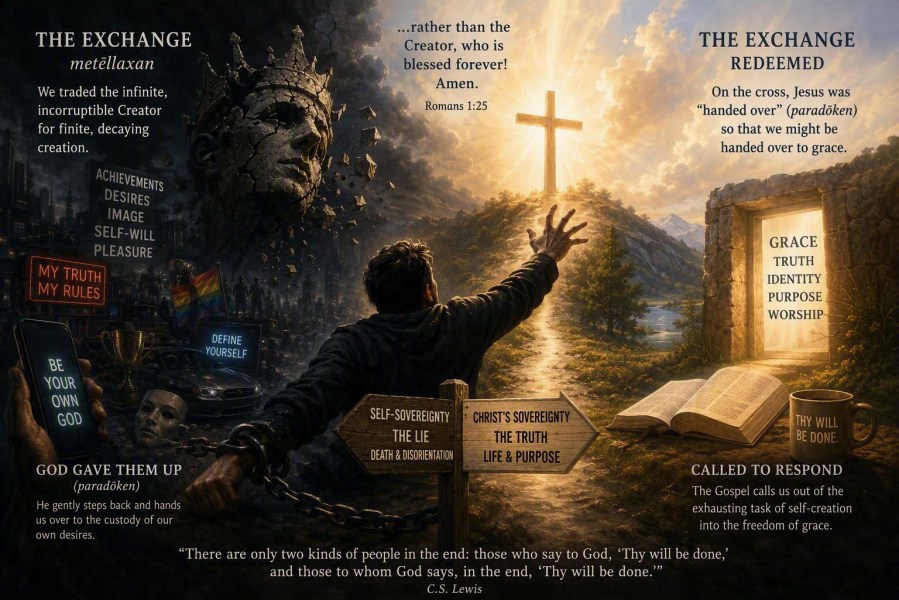
The Great Exchange

Romans 1:21–25 (ESV) For although they knew God, they did not honor him as God or give thanks to him, but they became futile in their thinking, and their foolish hearts were darkened. 22 Claiming to be wise, they became fools, 23 and exchanged the glory of the immortal God for images resembling mortal man and birds and animals and creeping things. 24 Therefore God gave them up in the lusts of their hearts to impurity, to the dishonoring of their bodies among themselves, 25 because they exchanged the truth about God for a lie and worshiped and served the creature rather than the Creator, who is blessed forever! Amen.

At the heart of human history lies a silent, catastrophic transaction. In Romans 1:21–25, Paul uncovers the tragic psychology of our spiritual downfall. The collapse of a human heart. This condition never begins with outward moral decay; it begins in the quiet sanctuary of the soul with two subtle postures: a refusal to honor God as God and a refusal to give Him thanks.

When we enjoy God’s gifts, our breath, intellect, relationships, and natural order, without acknowledging the Giver, we cut ourselves off from the Source of reality. Detached from truth, human reasoning becomes futile, our hearts are darkened, and in our self-proclaimed wisdom, we become fools.

Paul defines this collapse using a word rich with tragedy: “Exchanged” (metēllaxan) – to exchange, to substitute

We traded the infinite, incorruptible Creator for finite, decaying creation, and we swapped the truth, that God is supreme and worthy of ultimate allegiance, for “the lie” (tō pseudei), the ancient Edenic delusion that we can be our own gods, defining our own reality, morality, and identity.

We never stop worshiping. When we dethrone God, we simply crown something within the created order in His place: our achievements, our desires, our image, or our self-will.

How does God respond to humanity’s deliberate exchange? Three times in Romans 1, Paul repeats a haunting phrase: “God gave them up” (paradōken).

We often picture divine wrath as lightning from heaven or sudden, catastrophic destruction. But Paul reveals a far more sobering reality: God’s judgment is often judicial abandonment. Paradōken is a legal term meaning “to surrender a prisoner to custody.” When humanity demands freedom from God’s rule, God does not force His presence upon us. In His passive, judicial wrath, He gently steps back, lifts His restraining grace, and hands us over to the custody of our own desires.

C.S. Lewis wrote this about this condition: “There are only two kinds of people in the end: those who say to God, ‘Thy will be done,’ and those to whom God says, in the end, ‘Thy will be done.'”

Under Paul’s framework, sin becomes its own immediate punishment. The misery, relational breakdown, and loss of grounding we experience in a world detached from God are not arbitrary penalties; they are the natural, bitter fruit of getting exactly what we asked for: life without God.

In Romans 1:26–27, Paul demonstrates that our vertical rebellion against the Creator inevitably mirrors itself horizontally in our physical and relational lives. Using the exact same word, Paul writes that because humanity exchanged (metēllaxan) the truth of God for a lie vertically, we began to exchange natural design for what is contrary to design horizontally. When a society cuts the anchor of God’s sovereignty, the human body and identity are no longer seen as purposeful gifts to be honored according to the Creator’s wisdom. Instead, they become raw material to be redefined by human preference.

When we see cultural confusion, fractured identities, and the elevation of self-expression as the ultimate good, we are not looking at isolated political debates; we are looking at a world living in the shadow of paradōken. It is the poignant story of humanity insisting on self-sovereignty, only to discover the deep disorientation that follows when we try to manufacture our own purpose apart from the One who made us.

Yet, right in the middle of this sober diagnosis, Paul pauses in verse 25 to declare a spontaneous outburst of praise: “…rather than the Creator, who is blessed forever! Amen.”

Even when human culture actively rejects Him, God’s majesty remains unsullied and supreme. He is still the blessed Creator, full of grace and truth.

This doxology reminds us where our hope lies. The answer to a culture caught in “the exchange” is not hostility, moral outrage, or self-righteous pride. Left to ourselves, every single one of us has traded God’s glory for lesser things.

The Gospel calls us out of the exhausting task of self-creation and self-justification. On the cross, Jesus Christ was “handed over” (paradōken) to the full penalty of our rebellion so that we might be handed over to grace.

Refrences:

BDAG (Bauer, Danker, Arndt, and Gingrich): Bauer, Walter, Frederick W. Danker, William F. Arndt, and F. Wilbur Gingrich. A Greek-English Lexicon of the New Testament and Other Early Christian Literature. 3rd ed. Chicago: University of Chicago Press, 2000.

Thayer’s Greek-English Lexicon of the New Testament: Thayer, Joseph Henry. A Greek-English Lexicon of the New Testament. New York: American Book Company, 1889

TDNT (Theological Dictionary of the New Testament): Kittel, Gerhard, and Gerhard Friedrich, eds. Theological Dictionary of the New Testament. Translated by Geoffrey W. Bromiley. 10 vols. Grand Rapids, MI: Eerdmans, 1964–1976.

NIDNTTE (New International Dictionary of New Testament Theology and Exegesis): Silva, Moisés, ed. New International Dictionary of New Testament Theology and Exegesis. 2nd ed. 5 vols. Grand Rapids, MI: Zondervan, 2014.

C. S. Lewis, The Great Divorce (New York: Macmillan, 1946), chap. 9.

Image Created by Copilot AI based on text of post.

Two Sides of Divine Justice

Romans 1:16–18 (ESV) For I am not ashamed of the gospel, for it is the power of God for salvation to everyone who believes, to the Jew first and also to the Greek. 17 For in it the righteousness of God is revealed from faith for faith, as it is written, “The righteous shall live by faith.” 18 For the wrath of God is revealed from heaven against all ungodliness and unrighteousness of men, who by their unrighteousness suppress the truth.

Romans 1:17 and 1:18 mark a pivotal transition in Paul’s letter. Verse 17 concludes the thesis statement of the entire epistle, while verse 18 initiates Paul’s extensive, sobering diagnosis of humanity’s true condition.  We must be careful, though, because the artificial chapter and verse divisions (added centuries later) often cause readers to treat verse 17 as a triumphant conclusion and verse 18 as the start of a completely separate topic. Paul’s original readers would have experienced this as one continuous, seamless thought. In fact, verse 18 begins with the conjunction “For” (gar in Greek), directly connecting it to verses 16–17.

Paul deliberately uses parallel language to force a direct comparison. Both the righteousness of God and the wrath of God are actively being revealed (apokalyptetai).  Verse 18 explains why the Gospel in verse 17 is necessary in the first place. Without the reality of divine wrath against truth-suppression, the revelation of saving righteousness loses its urgency and meaning.

Divine wrath in Paul’s theology is not an emotional temper tantrum or an arbitrary outburst of divine frustration. It is God’s holy, settled, and judicial opposition to moral evil. The bright light of saving grace in verse 17 shines with breathtaking clarity only against the pitch-black backdrop of divine judgment in verse 18. Without verse 18, salvation (v. 16) has nothing to rescue humanity from.

How can a Holy God reveal both righteousness and wrath without contradicting His own nature? Because both flow from the exact same source: God’s absolute, unyielding moral justice.

When we look at the culture around us, and inspect the hidden corners of our own hearts, we witness humanity in an active state of suppression. Paul writes that people “suppress the truth in unrighteousness” (katechontōn, literally “stifling” or “holding down” the truth like a coil).

Listening to a Tim Keller sermon recently, he reminded me of a subtle shift happening in modern Christianity: churches are increasingly giving in to cultural pressure and scrubbing the word SIN from their vocabulary. In its place, we find gentler substitutes like “mistakes,” “brokenness,” or “bad habits.” While comfortable, these terms reshape our diagnosis into an internal psychological wound or a social misstep rather than a spiritual crisis. By contrast, Paul’s diagnosis in Romans 1 is far more severe. He defines sin as cosmic treason—the deliberate suppression of known truth, the refusal to offer God praise and gratitude, and the idolization of self-autonomy. When we soft-pedal sin, we rob humanity of the truth. Without a biblical framework for sin, we remain blind to our deepest reality: that our fundamental issue is not that we are flawed, but that we are in active rebellion against a holy Creator.

God’s truth is not secretive or hidden. Creation itself screams His eternal power and divine nature so clearly (Psalm 19) that humanity is left anapologētous, without a legal defense in the court of heaven. Yet, in our natural state, we choose to stifle what we know about God to preserve our own illusion of self-autonomy.

Humanity’s core problem is not a lack of intellectual information; it is a posture of self-sovereignty. We refuse to honor Him as God or give Him thanks. As a result, our thinking becomes futile, our foolish hearts are darkened, and we exchange the glorious, immortal Creator for decaying, created idols.

God’s justice in verse 18 responds to this rebellion judicially: He gives humanity over to the very choices they insist on making. But God’s justice in verse 17 offers a miraculous remedy: at the cross, God satisfied the full penalty His own justice required, allowing Him to remain entirely just while gifting a righteous legal standing to anyone who trusts in Jesus.

To understand Paul’s gospel is to realize that faith (pistis) is not merely intellectual assent to a set of spiritual facts. In Romans 1:5, Paul defines his whole apostolic mission as bringing about the “obedience of faith” (hypakoē pisteōs) among all nations. In the 1st-century Roman context, when an emperor took power, heralds declared a “gospel” (euangelion) demanding political allegiance from the empire’s subjects. Paul boldly hijacked that imperial vocabulary. He proclaimed that true, cosmic authority does not belong to Caesar or to the individual self. It belongs to Jesus Christ, the crucified and risen King.

To step into the grace of Romans 1:17, you must stop the truth-suppression of Romans 1:18.  You cannot receive the gift of God’s saving righteousness while actively sitting on the throne of your own life. Real faith is an act of joyful submission, a complete surrender of your self-autonomy to the King who bought you with His blood.

So, is there a specific area of your life (relationships, career, habits, finances) where you are holding down God’s clear truth to maintain control or pursue self-autonomy? What is one practical step of surrender that Jesus is asking you to make right now?

The Power of God

Romans 1:16–17 (ESV) – For I am not ashamed of the gospel, for it is the power of God for salvation to everyone who believes, to the Jew first and also to the Greek. 17 For in it the righteousness of God is revealed from faith for faith, as it is written, “The righteous shall live by faith.”

Paul was writing to the church in Rome—the imperial capital where military conquest, status, and intellectual philosophy drove identity. In a place where the cross was a symbol of total public disgrace, Paul states that he is not ashamed of the Gospel.

The Gospel is the active, royal “good news” that Jesus Christ has conquered sin and death through His crucifixion and powerful resurrection, establishing God’s reign and offering complete salvation to anyone who yields their trust and allegiance to Him.

In the Roman Empire, the word euangelion was an imperial term. It was used to announce political decrees—such as the birthday of Caesar, a military victory, or the ascension of a new emperor. Caesar’s “gospel” was backed by the military dynamis of the Roman legions.

Paul uses this exact Roman political vocabulary. He boldly claims that real, ultimate cosmic power does not reside in Caesar’s armies, economic dominance, or political coercion. The true dynamis that changes human nature is found in the self-sacrificial death and resurrection of a crucified Messiah.

The assertion that the Gospel is “the power of God” (dynamis theou) in Romans 1:16 is not merely a rhetorical flourish; it is the central engine of Paul’s entire theological framework. In contemporary thought, we often reduce the Gospel to a set of abstract propositions (ideas to be debated). In contrast, Paul uses dynamis to describe an effective, objective power in action. The Gospel does not merely talk about power; it is the instrument through which God releases His divine authority into the physical world.

In the original Greek, Paul does not write that the Gospel was the power of God (at conversion) or will be the power of God (in heaven). It is a present, continuous reality. The saving power (sōteria) of the Gospel operates across three distinct tenses in the believer’s life:

  • Past: Rescued from the penalty of sin.
  • Present: Rescued from the power of sin.
  • Future: Rescued from the presence of sin.

Believers never “grow out of” needing the Gospel. Sanctification requires the exact same divine dynamis as initial conversion.

In this gospel power, God reveals His divine righteousness. It demonstrates God’s perfect justice, fulfills His covenant promises, and offers an unearned, gifted legal status of right standing (justification) to sinners.

The Gospel’s saving power, revealed “from faith for faith,” is unlocked not by human performance, ceremonial rituals, or moral achievement, but purely by faith—a trust and loyal allegiance that operates from first to last.

Paul specifies the conduit through which this divine energy is unlocked: “to everyone who believes.” Faith is not a work that earns power; it is the empty hand that receives it. By making faith the sole receiving mechanism, God makes His saving power universally accessible—”to the Jew first and also to the Greek”—stripping away all human grounds for boasting or self-reliance.

What power are you trusting in each day?

Surrendering Our Throne

Romans 1:5

Romans 1:1–6 (ESV)

1 Paul, a servant of Christ Jesus, called to be an apostle, set apart for the gospel of God, 2 which he promised beforehand through his prophets in the holy Scriptures, 3 concerning his Son, who was descended from David according to the flesh 4 and was declared to be the Son of God in power according to the Spirit of holiness by his resurrection from the dead, Jesus Christ our Lord, 5 through whom we have received grace and apostleship to bring about the obedience of faith for the sake of his name among all the nations, 6 including you who are called to belong to Jesus Christ…

In a culture that endlessly preaches self-rule, autonomy, and “living your truth,” the Bible offers a radically different paradigm: the obedience of faith. When we hear the word obedience, our minds often jump to cold legalism, a list of rigid rules enforced by a distant judge. But the Apostle Paul pairs obedience directly with faith. In doing so, he reveals that true Christian faith is not merely passive mental agreement, an abstract feeling, or a static one-time decision. To place your faith in Jesus Christ is to acknowledge Him as the rightful King and Sovereign Lord (Kyrios). Authentic faith isn’t just accepting a ticket to heaven; it is the active, wholehearted surrender of your will to the One who created and redeemed you.

Let’s examine three dimensions of the obedience of faith in daily life:

Obedience is the Response to Grace: We do not obey God in order to earn His love or justify ourselves; we obey because He has already showered us with unearned grace. Faith sees His infinite goodness and naturally responds in loyal, loving allegiance.

Faith Yields the Throne: Secular autonomy insists, “I belong to myself, I rule my own life, and my personal desires are my highest authority”. The obedience of faith steps off the throne of the heart and declares, “My life belongs to King Jesus, and His Word anchors my reality”.

Trust Drives Action: You cannot truly trust a doctor without taking the prescribed medicine; similarly, you cannot truly trust Jesus as Savior without following Him as Lord. Real faith works itself out in practical, daily choices to honor Him.

When we stop striving to be the masters of our own destiny and yield to the “obedience of faith,” we find the paradox of the Gospel: true freedom is found in total surrender to Jesus Christ.

So ask yourself these questions:

  • Is there a specific area of your life (e.g., finances, relationships, career, habits) where you are still clinging to self-rule instead of yielding to Jesus as Lord?
  • How does viewing obedience as a joyful response to God’s grace differ from viewing it as a duty to earn His favor?
  • What is one practical step of “the obedience of faith” God is asking you to take today?

Additional Verses to reflect on:

  • Romans 1:5 – The direct foundational text for the devotional, establishing “the obedience of faith” (hypakoē pisteōs) as the goal of Paul’s gospel ministry.
  • Romans 1:1 – Paul’s self-identification as a doulos (bondservant/slave) of Christ Jesus, establishing the baseline of total surrender and non-autonomy.
  • Romans 1:16–17 – Demonstrates that the gospel is the saving power of God and that “the righteous shall live by faith” (quoting Habakkuk 2:4).
  • Romans 1:21–23 – The contrasting negative backdrop showing how autonomy, ingratitude, and the failure to honor God lead to spiritual darkness and idolatry.
  • Romans 16:26 – The bookend to Romans 1:5, confirming that the mystery of the gospel has been revealed to bring about the “obedience of faith” among all nations.
  • 1 John 5:3 & John 14:15 – New Testament cross-references on the link between love, trust, and keeping God’s commandments (“If you love me, you will keep my commandments”).
  • Ephesians 2:8–10 – The structural framework showing that salvation is by grace through faith alone, but naturally results in good works and active obedience prepared beforehand by God.

Closing Prayer

Heavenly Father,

I confess how easy it is to slide into self-autonomy – to act as though I am the ruler of my own life, my own decisions, and my own morality. Forgive me for the times I have treated faith as a passive idea rather than a living allegiance to King Jesus. Thank You for the radical grace You have extended to me in Christ. Today, I step off the throne of my heart. I ask for the strength of the Holy Spirit to produce in me the obedience that flows from genuine faith. Help me to trust Your wisdom above my own feelings, to honor Your Word above cultural trends, and to live every moment for the glory of Your name. In Jesus’ mighty and sovereign name,

Amen.

Dangers in Scripture Memorization

Psalm 1:1–2 (ESV)

1 Blessed is the man who walks not in the counsel of the wicked, nor stands in the way of sinners, nor sits in the seat of scoffers; 2 but his delight is in the law of the Lord, and on his law he meditates day and night.

While listening to a lecture, the professor mentioned something that made me think: does memorizing Bible verses really help if we don’t understand their context?

Memorizing the Bible is important, but doing it in isolation without context, meditation, or application can lead to unhealthy paths. The Bible is not just random sayings; it is a unified story of God’s redemption found throughout all of scripture.

So then, what are the dangers that we encounter in just basic scripture memorization?

  1. Verses learned in isolation can be misapplied. Take Romans 3:23 as an example: “for all have sinned and fall short of the glory of God.” This verse is often quoted, but it’s important to understand its context. Chapter 3 discusses the universal issue of sin and justification through faith in Jesus Christ. Paul highlights that both Jews and Gentiles are sinners and fall short of God’s glory, regardless of their background. Romans 3 is crucial in the book of Romans, leading to discussions on justification by faith and the importance of living a life of faith in response to God’s grace. Memorizing just this one verse, without reflecting on the entire passage, loses its richness.
  2. Memorization can become mechanical, like quoting lines from movies or reciting song lyrics without ever engaging our hearts.
  3. Focusing only on snippets can distort the larger theological and historical flow.
  4. It can be used to argue, manipulate, or judge rather than be used for edification.
  5. It can become a means to pride – Look how many verses I have memorized!

Psalm 1 tells us the true transformation away from sin is found in delighting in God’s word and meditating on it day and night. Memorizing the whole of Psalm 1 is a better exercise as it provides the context and richness of why we delight and meditate on God’s word.

So then, how should we memorize scripture?

Memorize in context: Learn passages or sections rather than isolated verses. This preserves flow and meaning. Reflect on the context of the entire passage or chapter of the book the verse is in.
Pair with meditation: Use reflective journaling so verses move from head to heart.
Seek Application: Ask simple questions like “How does this verse shape my choices today?”
Balance with study: Explore historical, linguistic, and theological contexts to avoid misinterpretation.
Pray Scripture: Turn passages into prayers to help ensures they transform your inner life, not just your memory.
Memorization is a doorway, not the destination. The danger lies in stopping at recall rather than pressing into understanding, transformation, and obedience.

When paired with meditation, context, and application, memorization becomes a powerful tool for spiritual growth rather than a hollow exercise.

Listen to the voice…

And he said, “If you carefully listen to the voice of Yahweh your God and you do what is right in his eyes and give heed to his commands and you keep all his rules, then I will not bring about on you any of the diseases that I brought about on Egypt, because I am Yahweh your healer.” (Exodus 15:26, LEB)

God’s people had just crossed the red sea by God’s mighty hand, and were crossing the desert and came to a place with water. The water was bitter, and they could not drink from it.

Instead of seeking God in prayer, the people grumbled against Moses. But this was not just grumbling to Moses, the people needed to learn to trust God for all their provision. Moses cries out to God as their mediator, so the Lord had him throw a piece of wood into the water and it turned sweet.

In Ex 15:26, it says that God made this regulation for them, and that he was testing them.

The plan is simple, trust the voice of your God and do what is right in HIS eyes. But the opposite of this is to not trust or do right in His eyes which has a consequence.

This pattern is repeated, instead of grateful hearts seeking the Lord in prayer they grumble and complained, so the Lord says again that He will test them to see if they will walk in His ways.

Today, in all that is going on in the world, death, disease, wars, and violence, it would be easy to fall into the same pattern that Israel did in the desert. But this is not what our Lord desires. In the book of James, the spirit led him to write these things…

Consider it all joy, my brothers, whenever you encounter various trials, because you know that the testing of your faith produces endurance. And let endurance have its perfect effect, so that you may be mature and complete, lacking in nothing. Now if any of you lacks wisdom, let him ask for it from God, who gives to all without reservation and not reproaching, and it will be given to him. But let him ask for it in faith, without any doubting, for the one who doubts is like the surf of the sea, driven by the wind and tossed about. For that person must not suppose that he will receive anything from the Lord; he is a double-minded man, unstable in all his ways.” (James 1:2–8, LEB)

Testing of our faith will come, but God is using it to grow us and bring us to maturity. It is very important in all of this that we do not repeat the mistakes of the past but seek God out for His wisdom. Pray earnestly and without doubt, for the Lord is good and desires for us to be more like His Son.

Paul in his letter to the Philippians encourages them with these words…

Rejoice in the Lord always; again I say, rejoice. Let your gentleness be made known to all people. The Lord is near. Be anxious for nothing, but in everything by prayer and supplication with thanksgiving let your requests be made known to God. And the peace of God that surpasses all understanding will guard your hearts and your minds in Christ Jesus. Finally, brothers, whatever things are true, whatever things are honorable, whatever things are right, whatever things are pure, whatever things are pleasing, whatever things are commendable, if there is any excellence of character and if anything praiseworthy, think about these things. And the things which you have learned and received and heard about and seen in me, practice these things, and the God of peace will be with you.” (Philippians 4:4–9, LEB)

So, let us not be anxious or grumble. Let us rejoice daily in the Lord and allow His peace to fill our hearts. Thinking every day about the good things that are true, honorable, pure, and commendable. Set our minds on things that are praiseworthy and learn from what we have been given. Practice what Paul said in Colossians.

Therefore, if you have been raised together with Christ, seek the things above, where Christ is, seated at the right hand of God. Set your mind on the things above, not on the things on earth. For you have died, and your life is hidden with Christ in God. When Christ, who is your life, is revealed, then you also will be revealed with him in glory.” (Colossians 3:1–4, LEB)

So, what does that look like…Pray, and pray often. Immerse yourself in the word of God and listen to his voice and not the voice of the world around you.

No Ordinary Worm

But I am a worm and not a man, scorned by mankind and despised by the people.” (Psalm 22:6, ESV)

Recently a friend of mine told me about a sermon he had heard on this passage in Psalm 22, he said that the Hebrew term used here for worm was not the normal word used for worm but had another meaning that I should look into. So the following is just a musing of what I have found so far…..

Psalm 22 is considered a Messianic Psalm, it is from this Psalm that Jesus quoted from the cross, “My God, my God, why have you forsaken me”

A person that was familiar with scripture would have recognized these words and possibly have pondered through the meaning of this Psalm in light of all that was happening both at that moment and most likely in the days that would follow.

Of particular interest is this statement in the Psalm “But I am a worm and not a man”. The word for worm in this verse is the Hebrew word “tola’at”. In most of the Bible dictionaries where I looked it up the word could be used as we see here “worm”, but it is also a word that is used to describe the color crimson or scarlet. How is it that this word could have both these meanings?

If you do a word search for the places this is used, you will find it used as a scarlet yarn that was used in the crafting of the High Priest’s garments to be worn for ministering in the Holy Place, the curtains and other fabrics of the tabernacle, it was also used in the coverings of things inside of the tabernacle.

It is thought that the word is a reference to the worm or grub know as (coccus ilicis or Kermes illicis) or more commonly called the crimson worm. The Encyclopedia Britannica has this as a definition…

 A species of scale insect in the family Kermesidae (order Homoptera), the common name of which also represents the red dye that is obtained from the dried bodies of these insects. The dye was often part of the tribute paid to conquering Roman armies, and, in the Middle Ages, landlords accepted it as payment for rent. The oldest known red dyestuff, resembling but inferior in color to cochineal, it was used by the early Egyptians.

Some commentaries on this passage refer to this worm and how it was used in the making of crimson dyes in the Mediterranean area. What most of the commentaries miss though is the fascinating life cycle of this bug.

The male coccus ilicis has wings and is able to fly. Though I have yet to verify the information, in my research I heard a presentation that said that the male hovers over the female during mating but never actually touches the female.

The female will only give birth one time and begins the journey by climbing onto a particular type of oak tree, or wooden post where she attaches herself permanently.

She then creates a hard-outer shell to protect the eggs she lays under her.

When the eggs hatch the babies feed on the flesh of the living mother who is now providing them life.

After a few days the mother dies and at that moment a scarlet liquid leaks out and colors the baby worms and the wood of the tree that it is on. This covering of red dye stains the babies for life.

Three days after the death of the mother, her body shrinks up into a heart like shape that is waxy and turns white. It has the look of wool and flakes off and looks like snow falling from the tree.

If the mother is harvested during the 3 days, the crushing of her body produces the dye that was used for the yarn and fabrics in the middle east and most likely the same process was used in the materials of the Tabernacle. The wax could also be harvested and was used to make shellac.

So, it has been suggested and it is hard to ignore the connections of the symbolism that is represented here. Let’s break it down….

  • Flying male hovering over the female to impregnate her.
    • Luke 1:35 – “And the angel answered her, “The Holy Spirit will come upon you, and the power of the Most High will overshadow you; therefore the child to be born will be called holy—the Son of God.
  • The female climbing onto a tree voluntarily knowing that she would die.
    • Jesus died on a wooden cross that he voluntarily allowed Himself to be nailed.
    • John 10:16–18And I have other sheep that are not of this fold. I must bring them also, and they will listen to my voice. So there will be one flock, one shepherd. For this reason the Father loves me, because I lay down my life that I may take it up again. No one takes it from me, but I lay it down of my own accord. I have authority to lay it down, and I have authority to take it up again. This charge I have received from my Father.”
  • The female worm secretes a hard shell to protect her offspring.
    • John 17:12 – “While I was with them, I kept them in your name, which you have given me. I have guarded them, and not one of them has been lost except the son of destruction, that the Scripture might be fulfilled.
  • The larvae stay alive by eating the flesh of their living mother.
    • John 6:51 – “I am the living bread that came down from heaven. If anyone eats of this bread, he will live forever. And the bread that I will give for the life of the world is my flesh.”
  • The larvae are permanently colored red by the death of the mother.
    • Eph 1:3-9 “Blessed be the God and Father of our Lord Jesus Christ, who has blessed us in Christ with every spiritual blessing in the heavenly places, even as he chose us in him before the foundation of the world, that we should be holy and blameless before him. In love he predestined us for adoption to himself as sons through Jesus Christ, according to the purpose of his will, to the praise of his glorious grace, with which he has blessed us in the Beloved. In him we have redemption through his blood, the forgiveness of our trespasses, according to the riches of his grace, which he lavished upon us, in all wisdom and insight making known to us the mystery of his will, according to his purpose, which he set forth in Christ”
    • Heb 12:24 – “and to Jesus, the mediator of a new covenant, and to the sprinkled blood that speaks a better word than the blood of Abel.
  • After the death of the mother she turns white and has the texture of wool and flakes off and falls to the ground like snow.
    • Mark 9:2-3 “And after six days Jesus took with him Peter and James and John and led them up a high mountain by themselves. And he was transfigured before them, and his clothes became radiant, intensely white, as no one on earth could bleach them.
    • Isaiah 1:18 ““Come now, let us reason together, says the Lord: though your sins are like scarlet, they shall be as white as snow; though they are red like crimson, they shall become like wool.

It is interesting to note that in Isaiah the word used for crimson is the same root used in the word worm in Psalm 22.

Is this coincidence? Maybe we are reading into the passage more than what is really there? Or maybe, our God is so infinitely majestic and powerful that he gave unique symbolism throughout His Creation to point us to the work of His Son. I will let you decide, but it is all very interesting.

Enlightening the Eyes

“the commandment of the Lord is pure, enlightening the eyes;” (Psalm 19:8b, ESV)

The day that I am writing this is in the time of the counting of the Omer and in just a short while, we will have arrived at Shavuot, the day that it is believed that God gave the commandments from Mt Sinai to the people of Israel.

It is wonderful that the part of Psalm 19 that I am looking at today is focused on “the commandment of the Lord”.

What does this word commandment really convey to us? What does it mean that it is pure, and how does it enlighten the eyes?

The Hebrew word for commandment here is “mitzvah” and if we were to look at a handful of verses where the word is used, you should get a fairly good idea of what it conveys….

“Now this is the commandment—the statutes and the rules—that the Lord your God commanded me to teach you, that you may do them in the land to which you are going over, to possess it, that you may fear the Lord your God, you and your son and your son’s son, by keeping all his statutes and his commandments, which I command you, all the days of your life, and that your days may be long.” (Deuteronomy 6:1–2, ESV)

Know then in your heart that, as a man disciplines his son, the Lord your God disciplines you. So you shall keep the commandments of the Lord your God by walking in his ways and by fearing him.” (Deuteronomy 8:5–6, ESV)

“For this commandment that I command you today is not too hard for you, neither is it far off. It is not in heaven, that you should say, ‘Who will ascend to heaven for us and bring it to us, that we may hear it and do it?’ Neither is it beyond the sea, that you should say, ‘Who will go over the sea for us and bring it to us, that we may hear it and do it?’ But the word is very near you. It is in your mouth and in your heart, so that you can do it.” (Deuteronomy 30:11–14, ESV)

Yet they did not listen to their judges, for they whored after other gods and bowed down to them. They soon turned aside from the way in which their fathers had walked, who had obeyed the commandments of the Lord, and they did not do so.” (Judges 2:17, ESV)

My son, if you receive my words and treasure up my commandments with you, making your ear attentive to wisdom and inclining your heart to understanding;” (Proverbs 2:1–2, ESV)

My son, keep your father’s commandment, and forsake not your mother’s teaching. Bind them on your heart always; tie them around your neck. When you walk, they will lead you; when you lie down, they will watch over you; and when you awake, they will talk with you. For the commandment is a lamp and the teaching a light, and the reproofs of discipline are the way of life,” (Proverbs 6:20–23, ESV)

At a top level, the word seems to be pretty strait forward. It is used in the sense of a father’s instruction to his son, or a king to his servants, and when we put it in perspective of the words of Jesus, that the Kingdom of God is at hand, then we see a structure for a culture where we are ruled by God’s instruction and in that, he desires that we walk in obedience to those instructions. What is very important to see, especially in light of Deut 30:11-14 is that they are not very difficult for us, and it would seem that the Lord provides all the means and ability to accomplish His instruction. If you continue to pour through the many verses that contain this word you will also notice that God desires to bless those who walk in obedience to His commands, and yet as in the Garden of Eden, rebellion against his instruction brings forth discipline. Again, the perfect model of a father-son relationship.[1]

So, what does it mean that God’s instructions are pure? The Hebrew word here is “bar” and at it’s root has the sense of being pure, radiant, bright, and clean. The Theological Wordbook of the Old Testament speaks of the Arabic variation of the word having the sense of reverent, dutiful, devoted, kind, charitable, virtuous, and good. It also mentions that in Akkadian the verb form has the meaning of “to glitter” and as an adjective, the word means pure, as in a pure metal with no contaminates. Looking through the Psalms and Proverbs the adjective also has the sense of something pure or a quality of moral purity.[1]

The next word to consider is the word “enlightening” which has at its root the Hebrew word “or” which is the same word used for light. This word has variations that are translated as shine, give light, brighten, Glorious, shining brighter and brighter, and simply give light. The word can also mean “to become light”.

Finally, we must think about the word for “eyes”. It is the Hebrew word “ayin” and I really like what the Theological Wordbook provides as an opening to its explanation of this word…

More than the eye itself is implied by this word. Occasionally it represents the whole process of seeing and by extension, of understanding and obedience (Jer 5:21). However, in the ot it is the ear which is generally used in this figurative way. The eye is used to express knowledge, character, attitude, inclination, opinion, passion, and response. The eye is a good barometer of the inner thoughts of man.[1]

So, a good way to think about this verse is that God’s instruction is so perfect and pure that as we gaze upon its beauty, it will give us understanding, help us walk a life of obedience, it has an impact on our character, attitude, inclination, passions and ultimately, if the eye is a good barometer of the inner thoughts of a man, then God’s instructions should reveal when our thoughts are not where they need to be and bring us to a place of repentance.

Let us gaze diligently at the beauty of God’s instruction and let it transform our lives into lives that are full of understanding, and a desire to walk in humble obedience to our God.

[1] Schultz, C. (1999). 1612 עִין. R. L. Harris, G. L. Archer Jr., & B. K. Waltke (Eds.), Theological Wordbook of the Old Testament (electronic ed., p. 662). Chicago: Moody Press.